Attackers have AI.
Now your defenses do too.

Qvasir is an AI-native detection and response platform, built from three layers in the right order: detection logic you can read, automation that keeps it measured, and AI only where it adds value a team cannot. It ingests any telemetry, runs your entire library in real time, investigates the alerts that clear the gates, and hands your team qualified incidents — with timeline, evidence, and recommendations. Not another queue of alerts.

MITRE ATT&CK® aligned OCSF classified Runs in your environment Every AI action audited

The reduction, measured

  1. 39.1Mraw events ingested
  2. 13,179signals
  3. 321correlated, scored alerts
  4. 20incident candidates
  5. 2escalated to a human

Measured in a demonstration environment. Eighteen of the twenty candidates were investigated and dismissed as false positives by the platform — not by your analysts. That last step is the whole product. See what an escalation looks like →

The problem

AI collapsed the cost of attacking. It hasn't collapsed the cost of defending — until now.

Generated phishing, automated recon, exploit code hours after disclosure: offense is scaling with machines. Defense still scales with people — analysts triaging an alert queue that grows faster than any team can hire.

The traditional answer is three vendors: a SIEM license, a SOAR project, and an external SOC contract. Sprawling integration work, and a queue that still ends with a human reading raw alerts.

Qvasir replaces that stack with one system in which deterministic rules and correlation do the reading, automation does the mapping, tuning and verification, and AI does the investigating — and it escalates only what deserves a decision.

What you get

The unit of output is a qualified incident — not an alert.

When Qvasir escalates, the investigation is already done. Each incident arrives with:

  • A reconstructed timeline across every involved log source.
  • Entity context — the users, hosts, and processes involved, and how they relate.
  • The investigation itself — the checks the AI agents ran, which tools they used, and what each returned.
  • MITRE ATT&CK® mapping of the observed behavior.
  • Recommendations — concrete next actions, in priority order.

Your analysts start where an external SOC's tier-2 handoff would end — without the external SOC.

Read a full example report →
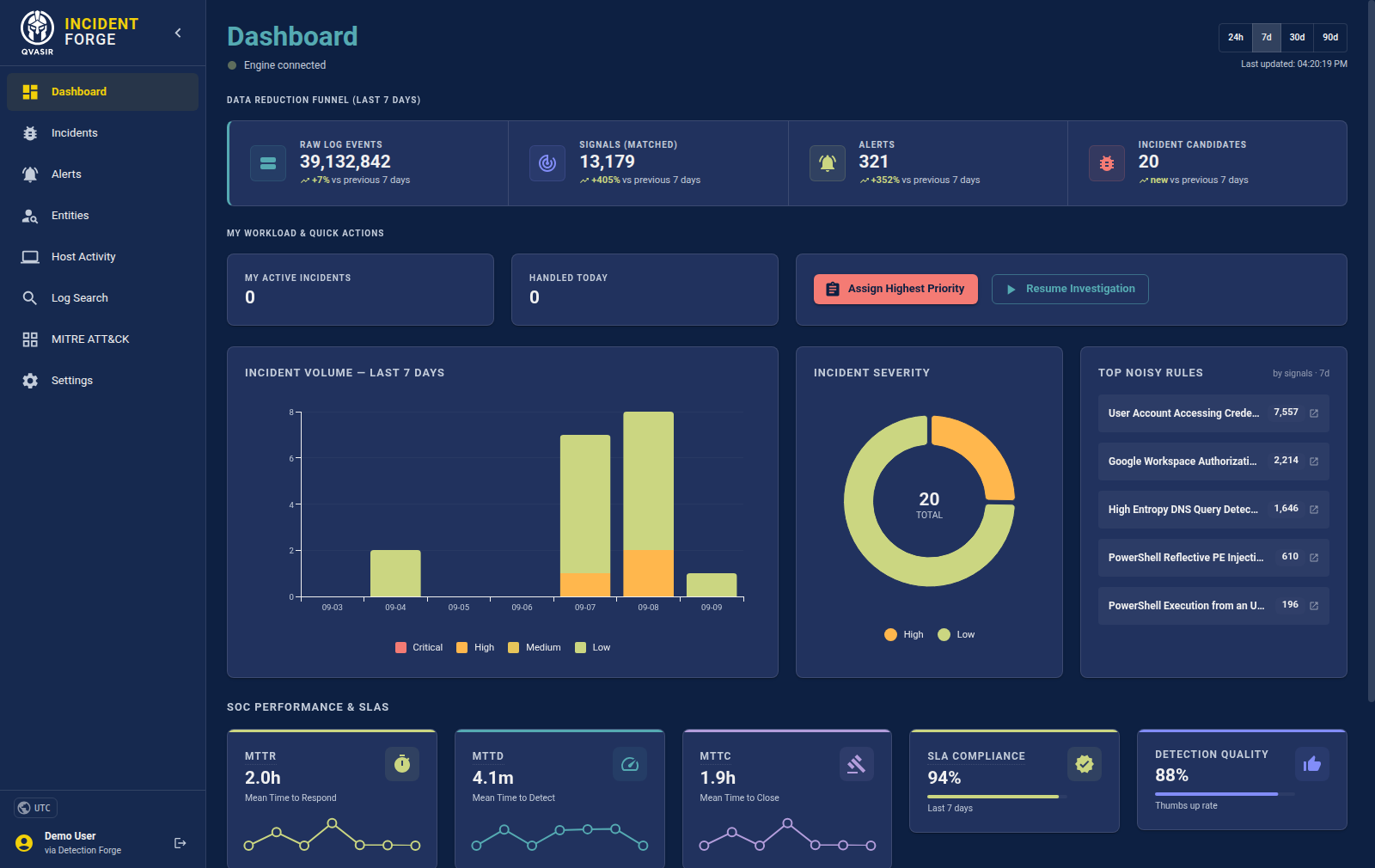
Incident dashboard with the data reduction funnel: 39.1 million raw events reduced to 13,179 signals, 321 scored alerts and 20 incident candidates
The incident dashboard in a demonstration environment — the reduction above, as the platform reports it.

How it works

One pipeline from raw telemetry to a decision-ready incident.

A source you onboard this morning can be carrying validated detections this afternoon — no content pack, no vendor waiting list.

01 · Ingest

Any source, any environment

Cloud, on-prem, infrastructure, OS, applications. Streaming ingestion classifies every source into the OCSF taxonomy and tracks schema drift as your estate changes.

More →
02 · Author

Detections for any source you onboard

Qvasir drafts detections against a source's measured schema — the fields and values it actually has — then validates and backtests each one before it goes live.

More →
03 · Detect

Real time, at scale

A purpose-built engine holds your whole rule library live, with correlation, aggregation, and low-and-slow layers on top of first-pass matching.

More →
04 · Improve

Detections that get better

Every rule is mapped to ATT&CK automatically and tuned continuously from observed results — including candidate detections generated from the vulnerabilities on your radar.

More →
05 · Investigate

Logic decides what is worth it, agents do the legwork

Entity-aware scoring — deterministic, in windows you can reason about — decides what deserves an investigation. Only then do AI agents work it, with secure, audited tool access, and deliver qualified incidents with recommendations.

More →

Trust

Security by design — because we're a target too.

Least privilege throughout

Hardened containers, non-root services, capability-scoped tool access for AI agents — enforced server-side, failing closed on scope errors.

Single identity authority

One authentication and authorization domain across the whole platform, with MFA and WebAuthn support built in.

Complete audit trail

Every system activity is logged and attributable — human and AI alike. If an agent looked something up, you can see when, why, and what it found.

Open foundations

Built on the standards you already trust.

No proprietary lock-in on your data or your detections. Qvasir is built on best-of-breed open standards and open-source infrastructure — your events are OCSF-classified, your coverage is ATT&CK, your infrastructure is open.

MITRE ATT&CK® OCSF Kafka-compatible streaming Vector ClickHouse® PostgreSQL

Full component list, licenses & attributions →

The economics

One system. Fewer line items. No external SOC retainer.

Qvasir consolidates what is usually bought as three products and a service: the SIEM, the SOAR, the detection engineering, and the managed SOC that reads the output. The comparison that matters isn't per-GB pricing — it's what you have to staff, license, and wait for.

Traditional SIEM
(e.g. Splunk®, Microsoft Sentinel)
SIEM + MDR service Qvasir
What arrives in your queue Raw alerts to triage Analyst summaries, on the provider's SLA Investigated incidents with timeline, evidence & recommendations
Detection engineering Your team writes and maintains rules Provider's generic rule pack Generated from your data, tuned continuously from results
Coverage visibility Manual ATT&CK mapping projects Periodic provider reports Automatic ATT&CK mapping & live coverage reporting
Cost model Ingest-volume licensing — grows with your data License + per-seat/per-asset retainer Platform pricing — designed to decouple cost from data volume
Your existing security tools Another integration project, per tool Provider works in their own tooling Ingested and correlated as sources — EDR, firewall, email, cloud, identity
Where your data lives Vendor cloud or your infra Shared with the provider Your environment — cloud, on-prem, or air-gapped

Comparison reflects typical deployment models; individual vendor offerings vary. Air-gapped Qvasir deployments run ingest, detection, and search fully offline; AI-assisted onboarding, authoring, and investigation require reachability to the AI provider you choose.

Where this goes

From detection to response — on your policy. Roadmap

The investigation layer is the foundation for what comes next: policy-driven automated response — block traffic, isolate a system, lock a compromised account within minutes of first signal — plus built-in user interaction for fast feedback and analyst/CSIRT notification with response agents attached.

See the roadmap →