The guardrail that matters
The AI can make this more cautious. It cannot make it look safer.
This is the part worth reading carefully, because it is a design decision rather
than a feature. Wherever a model touches a live detection, what it is permitted to
do is constrained by code — not by an instruction in a prompt that a cleverly-worded
log line might talk it out of.
A one-way ratchet on trust
The AI reviewing your calibration results can demote a value to "review
carefully" or attach a warning. It structurally cannot approve a value, raise a
confidence score, or change any number — the merge is an add-only operation.
And if a merge ever ended up relaxing the deterministic verdict, the entire AI
contribution is discarded rather than trusted. It can only ever narrow.
Scope-locked to the part it was asked about
When it refines a rule from a tuning suggestion, it may change the detection
logic and the tunables. Anything it returns outside that scope is reverted
before you ever see it — so "fix the false positives" cannot quietly become a
rewritten severity, a changed source binding, or a new set of ATT&CK
tags.
It is allowed to disagree with you
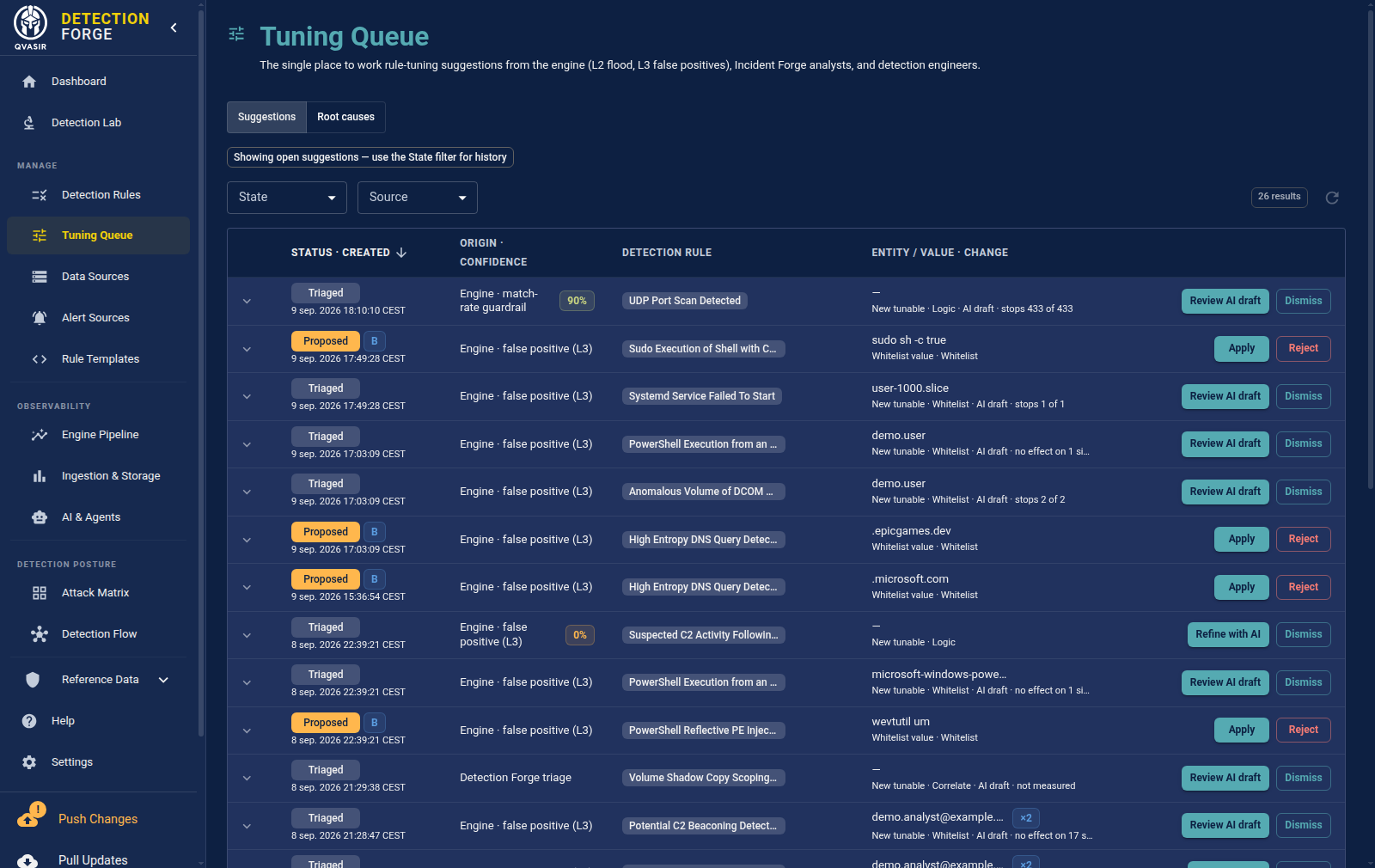
Hand it a tuning suggestion and it can come back rejecting it, per suggestion,
with a reason. An assistant that implements every instruction including the bad
ones is not much of a safeguard.
It never sees the raw events
Calibration data contains values an attacker can influence — a hostname, a
filename, a command line. Those are fenced inside a delimited block that is
regenerated per run, and the model reasons over aggregates rather than the raw
stream. Prompt injection through your own telemetry is a real attack on a
platform like this one.
The pattern underneath all four is the same: the AI proposes, deterministic code
decides what a proposal is even allowed to be, and a person applies the ones that
reach a live system. Every applied change lands in the rule's own version history.