Why Qvasir

Replace a stack.
Keep control.

Detection and response is usually assembled: a SIEM for storage and search, a SOAR for automation, consultants for detection content, and an MDR contract to read the output. Qvasir is what that stack was trying to be — one system, in your environment, delivering decisions instead of raw material.

For the security manager

Your constraint is rarely tooling. It is that the work scales with people and the budget does not — so the question is what a team of the size you can actually hire is able to cover. Qvasir is built to change that ratio rather than the headcount.

One engineer should operate like a team

Detections are drafted against your measured schema, validated before they ship, mapped to ATT&CK automatically, and tuned from observed results. The work that used to need a detection-engineering function becomes one person's reviewed queue.

The queue is qualified before it reaches anyone

In a demonstration environment, 39.1 million events became 13,179 signals, 321 scored alerts, 20 incident candidates — and 2 escalations, because the platform investigated the other eighteen and dismissed them itself. That ratio is what your analysts' time is actually spent against.

See the reduction →

Coverage you can present

A live MITRE ATT&CK® coverage matrix replaces the annual mapping spreadsheet — with gaps ranked, so next quarter's plan is something you read off a screen rather than defend from memory.

You replace the expensive layer, not your sensors

What goes is the SIEM licence, the SOAR project and the MDR retainer — the costly middle that stores, automates and reads. What stays is everything that produces signal: your EDR, firewall, email security, cloud posture and identity tooling all onboard as sources, and their alerts get correlated with the raw telemetry underneath them.

How existing tools onboard →

No external SOC dependency

Qualified incidents with timeline, evidence, and recommendations arrive without a retainer or an SLA negotiation — the only external call is to the AI provider you choose.

Audit-ready by default

Full activity trails — human and AI — support internal audit, regulatory review, and post-incident reporting without reconstruction work.

For the SOC and CSIRT

Removing the external SOC dependency does not remove the shift. The people who carry the pager are the ones whose day changes most, so the console is built for the way they actually work.

You open an incident, not an alert

Signals are correlated, scored, and investigated before anyone is paged. What reaches the queue is a qualified incident carrying its own timeline, the entities involved and how they relate, the agent's trace of which tools it called and what each returned, the evidence, and recommended actions in priority order. Your shift starts at the decision. The raw alert stream is still there when you want to look upstream — it just isn't where you live.

Every incident carries its own lifecycle

Incidents move through NIST phases with the clock running: time to detect, respond, and close are measured per incident, not reconstructed at quarter-end. Assignment and handover are explicit, and closure uses a defined reason rather than free text — so the record is comparable across shifts.

The record writes itself as you work

Each phase is documented where you handle it, evidence is held with its chain of custody, and the incident report exports with both attached — so the post-incident review, the regulator's question, and the customer's question are answered from work you already did. Searches you build are saved for the next shift, not retyped.

Closing a false positive fixes it

Your verdict on an investigation is an input, not paperwork. Analyst feedback and the agents' own false-positive findings both open concrete tuning suggestions against the offending rule — reviewed and applied by a human. The alert you close at 03:00 is one you stop seeing.

And instead? What goes away is the qualification work — the reading, pivoting, and dead ends that filled a shift before anyone could decide anything. The hours come back as hunting your own estate with entity history, host timelines, and log search; as turning what you find into a detection in the same platform, without filing a request to another team; and as working the ATT&CK gaps the coverage matrix has already ranked for you. The analysts who were closing tickets start closing gaps.

For the detection engineer

Detection content is the product of this platform, so authoring it is a first-class workflow rather than a text box bolted to a search bar — with the schema, the validation, the backtest and the coverage matrix all in reach of the editor.

Author against the data you actually have

The schema behind every source is measured from real events — which fields are present and how often, how many distinct values they carry, what those values look like. A rule is validated against the schema of the specific source and event type it targets, so "that field does not exist here" is caught while you write it, not by silence in production.

Prove it before it ships

Structural, semantic, and field-level checks run on demand, with a quality score and every error located in the rule. Calibrate against historical events to see what it would have caught and what it would have cost you. Rules move Draft → Testing → Production deliberately, and the engine reports back whether each one is actually loaded and firing.

Rules are text, and the text is yours

Detections are readable FDL in git — reviewable in a pull request, diffable, and versioned per rule with its own history. Nothing is trapped in a proprietary editor, and the correlation, aggregation, and low-and-slow layers are expressed in the same grammar as a simple match. Between readable rules, per-rule history, and the agent's trace on every investigation, "why did it do that?" always has an answer.

Read real rules in FDL →

The backlog writes itself

Every rule is mapped to ATT&CK as it is created, and the coverage matrix ranks what is missing — so the next detection to build is a decision you read off a screen rather than one you argue about. Tuning suggestions arrive with the evidence, the rationale, and a confidence attached.
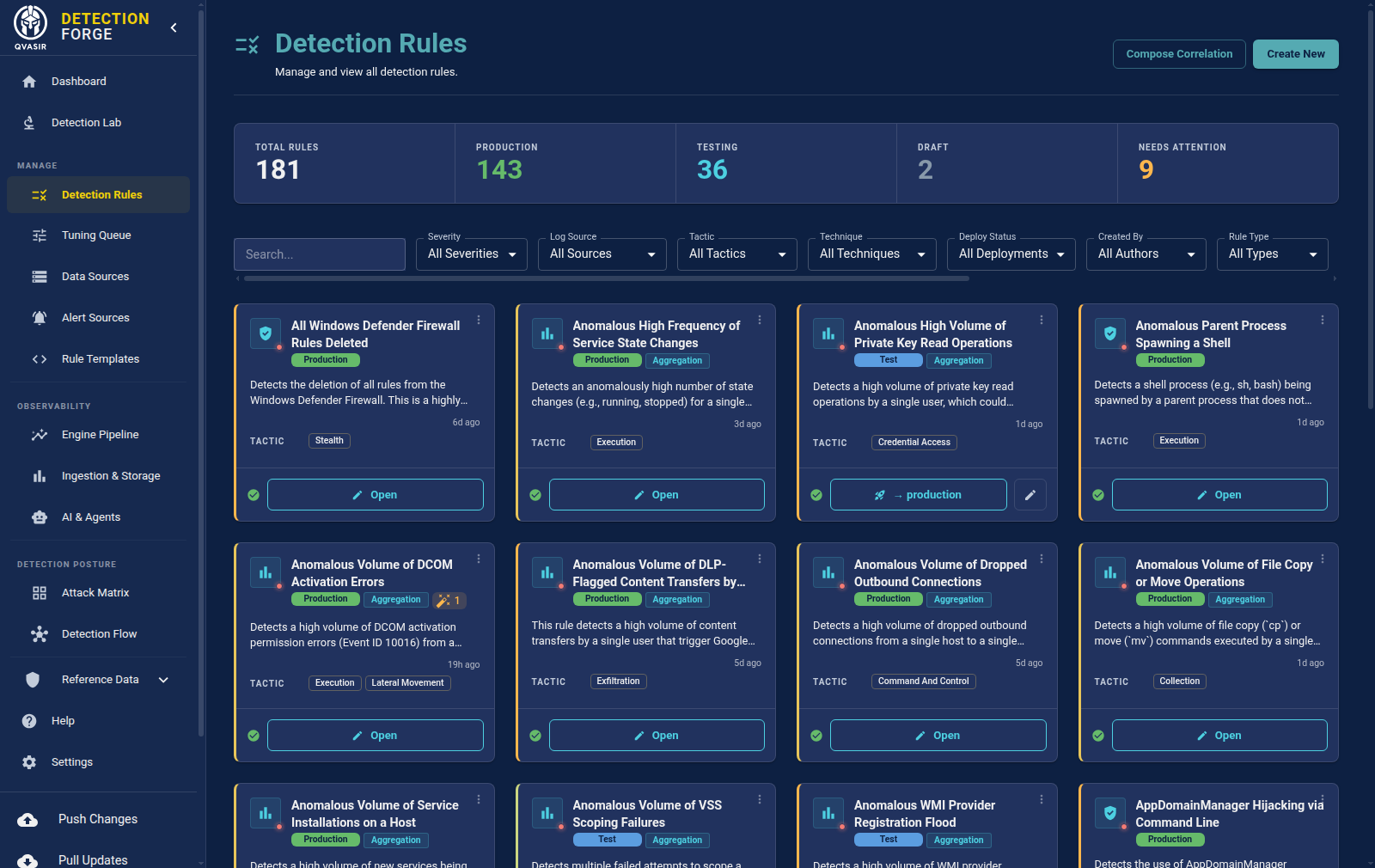
Detection rule library in a demonstration environment: 181 rules total, 143 in production, 36 in testing, 9 flagged as needing attention — each rule card showing its deployment state, correlation or aggregation type, and mapped ATT&CK tactics
One engineer's rule estate in a demonstration environment — 181 detections, 143 of them in production, each mapped and filterable by tactic, technique, source and deployment state.

For procurement

Fewer line items

One platform where budgets usually carry SIEM licensing, SOAR licensing, professional services for detection content, and an MDR retainer.

Cost decoupled from data growth

Ingest-volume licensing punishes visibility: the more you can see, the more you pay. Qvasir's platform model is designed so onboarding more telemetry is a security decision, not a budget negotiation.

Open foundations, low running cost

The infrastructure underneath is open source — collection, streaming, event store, database — so there is no stack of per-component licences accruing beneath the platform you bought. Events are OCSF-classified and detections are readable versioned text in a documented grammar, so the exit is cheap too: you take your data, and every line of your detection logic stays readable by whoever you hand it to.

Component list & licences →

For the full side-by-side with traditional SIEM and MDR models, see the comparison on the homepage. For a pilot scoped to your environment and telemetry, talk to us.